

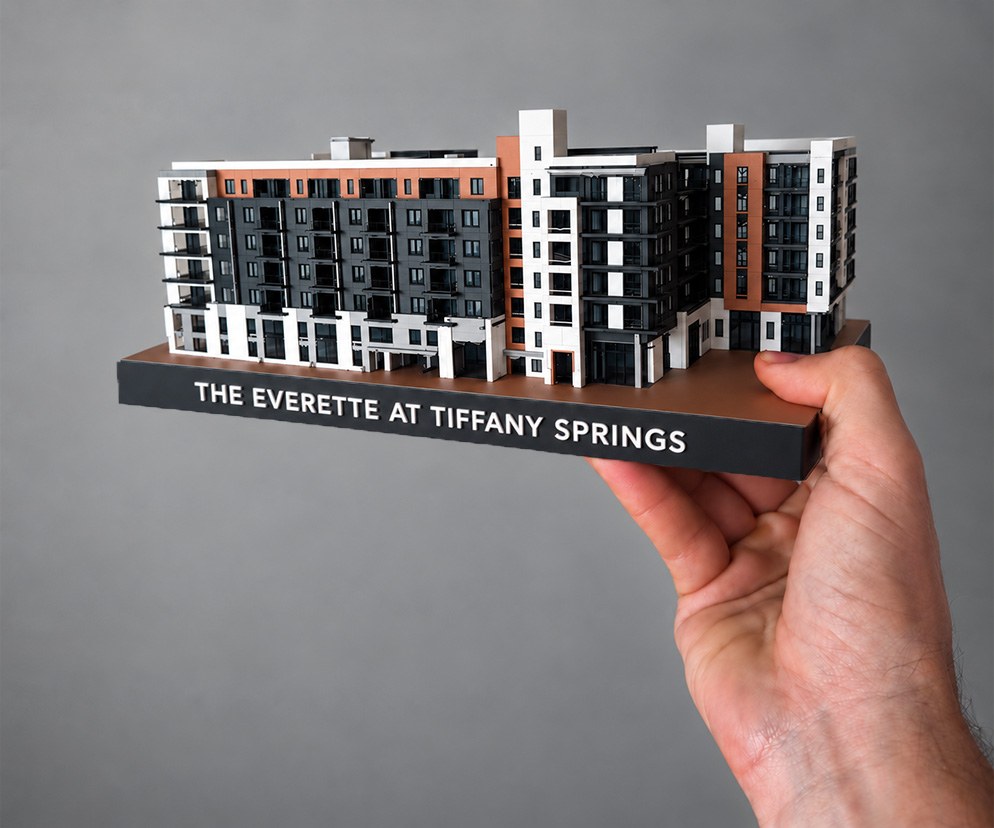
Most groundbreaking gifts celebrate the ceremony: a ceremonial shovel, a hard hat with the date on it, an engraved plaque, something branded for every guest. They’re fine keepsakes of the day. What they don’t show is the building, which is the thing everyone in the photo came for. A scale model of the project does, and it stays on the owner’s desk long after the shovels are put away.
I build 3D-printed architectural models of real buildings for general contractors, developers, and owners, printed in-house from the project’s Revit model. I’ve spent 10+ years in construction & VDC, including 4 on-site, working inside models like these: BIM coordination on 600 Guadalupe, a $325M tower that was the tallest building in Austin at topping out, and 4D sequencing on the $550M Neuhoff Development in Nashville. Here’s how a model works as a groundbreaking ceremony gift and at each milestone after it, what goes on the base, and how far ahead to order.
The usual groundbreaking gift ideas, and where they end up
Look up groundbreaking gift ideas and you’ll find the same short list: gold or chrome ceremonial shovels, engraved hard hats, acrylic plaques with a rendering inside, and branded giveaways for the guest list. There’s nothing wrong with any of them. The ceremonial shovel is a real tradition, and plenty of owners mount one on the wall.
The catch is that they’re all about the event. A hard hat says “I was there.” It doesn’t say what was built, and it’s easy for it to end up in a box by the next office move. For a GC or a developer, a gift is also a business tool. It’s what keeps your firm’s name in front of the owner, the board chair, or the donor until the next project comes around, and that only works if it stays out.
A model of the actual building, printed from the real design
A scale model works differently because it isn’t a stand-in. It’s printed from the project’s own Revit model, the same model the design team and the builder are already working from, so the massing, the proportions, and the roofline match the drawings. Nobody reshapes it by eye along the way.
That matters to the person receiving it. An owner who spent years getting a project financed, designed, and permitted knows exactly what the building looks like. A generic tower on a base reads as a prop. Their building, at desk size, reads as the project.
If there’s no model to print from yet, I’ll build the Revit model from the drawings first. For a building that doesn’t exist yet, that means elevations of every side, not just a rendering. A single rendering usually shows one or two faces, and the model needs all of them.
Groundbreaking, topping out, ribbon cutting: which model fits which milestone
Groundbreaking: the finished building, before it exists
At a groundbreaking, nobody has seen the building yet except on paper and on screens. A full-color model of the finished design, in up to five colors so the brick, the metal panel, and the trim each read as their own material, is the first physical version of it the owner gets to hold. It’s printed from the design as it stands at the groundbreaking, and you approve a color proof before anything prints, so the model matches the set the owner just signed off on.
Topping out gifts: the structure, the way the crew built it
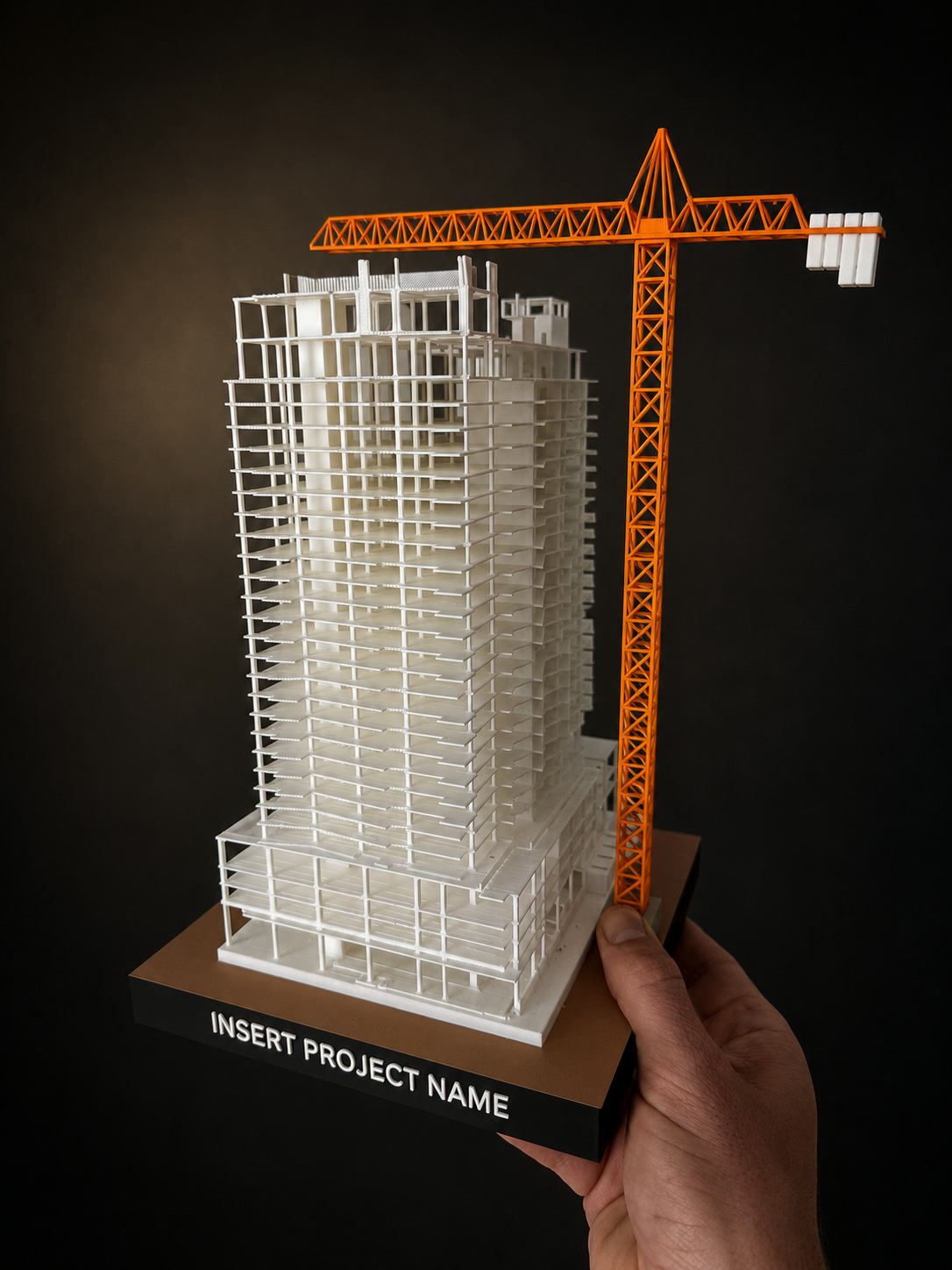
Topping out is the builder’s milestone. The last beam goes up, often signed by the crew, and the frame is complete. A structural model fits that moment. It prints the frame straight from the structural Revit model, with the columns, floor plates, cores, and framing, in one clean color or with the steel in its own color so the structure reads at a glance. A removable tower crane is an option, so the model can show the job mid-build. Owners and developers keep one as a milestone piece, and a matching set works for the project team.
Ribbon cutting gifts: the finished building, for everyone who built it
By the ribbon cutting, the building is real, and so is the list of people who made it happen: the owner, the design team, the GC, the trade partners, and the people who funded it. A full-color model of the finished building works for all of them, and matching copies make it practical to give one to each. At closeout, the same model doubles as a team-recognition piece.
A shovel marks the day. A model of the building marks the project.
What goes on the base
Every model ships on an engraved display base. Included at no extra charge:
- The project name and the milestone date, engraved into the base
- Your logo or the owner’s, from a vector file (SVG, AI, or EPS)
- A color proof before anything prints, approved by you in writing
Team members’ names and titles for a team set, or the removable tower crane, go on your written estimate when you want them. The proof is the moment to catch a wrong color, a misspelled name, or a roofline that changed in the last design revision, while it’s still a quick fix instead of a reprint.
Construction client gifts for the whole room
A single model for the owner is the simplest version, but most milestone gifts work better as a set. Once the model exists, a copy is mostly print time, so matching copies cost less than the first model. That’s what makes it a realistic construction client gift for more than one person. Who gets one depends on the market:
- Healthcare: hospital leadership, and the foundation’s lead donors on an expansion
- Education: the board members and administrators behind a school or campus project
- Sports: the donors and athletic staff whose names go on a stadium or a facility
- Mixed-use and residential: the developer’s partners and investors, plus one for the leasing or sales office. For single-family builders, there’s a separate lane for home models as closing gifts.
For a number, the instant estimate on the scale models page gives you a preliminary price on the spot, and what a 3D-printed architectural model costs covers what moves it.
How far ahead to order
Plan on 2–6 weeks, depending on the size, the finish, and my workload. A single model moves faster than a full team set, and a model larger than 12 inches, which prints in sections, or a Full Color + Acrylic Windows model takes longer. Count back from the ceremony date, leave room for shipping, and tell me the date when you ask for an estimate so I can confirm the schedule before you commit.
What I need to start:
- The Revit or BIM model, ideally. The architect or the GC usually has it, and if I’m already on the project’s 4D animation or BIM coordination, I likely have it too.
- No model? Send the drawings, with plans and elevations of every side, and I’ll build the model before printing.
- The base details: the project name, the date, your logo file, and any names.
For the step-by-step from file to finished piece, see how a 3D-printed scale model gets made.
A groundbreaking is the first time an owner stands on the site of a building that only exists in drawings. A model of that building, with the project name and the date on the base, keeps that moment on their desk while the real one goes up.
Frequently asked questions
What are good groundbreaking ceremony gifts?
Ones that show the building, not just the event. Ceremonial shovels, hard hats, and plaques mark the day. A 3D-printed scale model of the actual project, printed from the real design model with the project name and date engraved on the base, is the one that stays on the owner's desk for years.
What is a good topping out gift?
A structural model of the building: the columns, floor plates, cores, and framing printed from the structural Revit model, in one color or with the steel in its own color, plus an optional removable tower crane. It marks the moment the frame is complete, which is what a topping out celebrates.
Can you make a model of a building that hasn't been built yet?
Yes, and for a groundbreaking that's the usual case. I print from the project's Revit or BIM model, or build the Revit model first from the drawings. I'll need elevations of every side, because a single rendering usually shows only one or two faces. You approve a color proof before anything prints.
How far ahead should I order a groundbreaking gift?
Plan on 2–6 weeks, depending on the size, the finish, and my workload, plus shipping. A full team set or a model larger than 12 inches takes longer than a single model. Tell me the ceremony date up front and I'll confirm the schedule before you commit.