
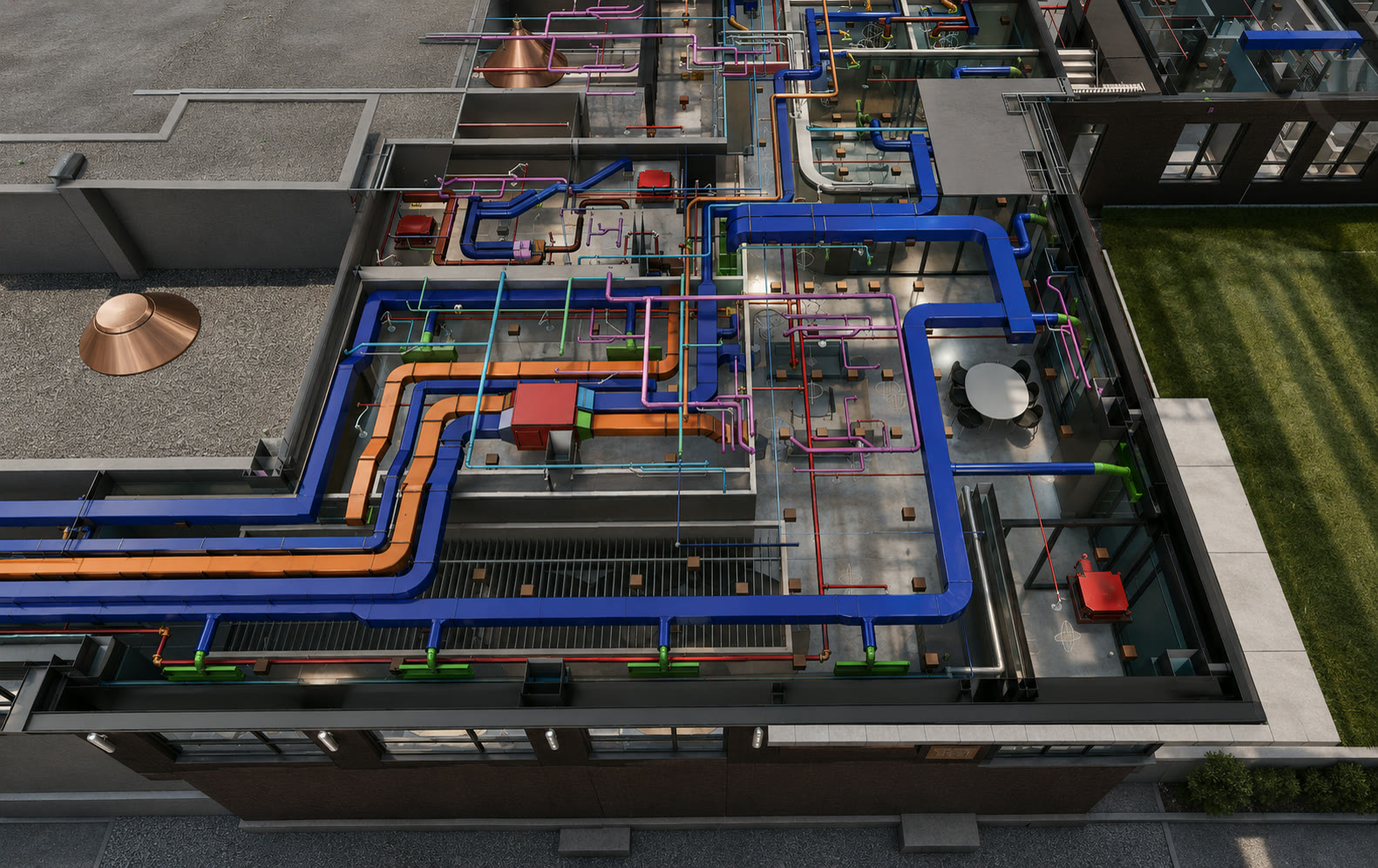
BIM Consulting: Build Your In-House BIM Team
Outsourcing BIM coordination forever was never really the plan — it was the fastest way to get coordination running while everything else on your team caught up. At some point the volume justifies bringing it in-house, and that transition either happens deliberately or it happens badly: a hire made without a hiring plan, standards nobody wrote down, software chosen ad hoc, and a vendor relationship that just quietly ends instead of graduating into something better.
I help general contractors, developers, architecture firms, and engineering firms build that in-house BIM department on purpose — the hiring plan, the standards, the software stack, the training — and I stay on as the bridge, running your live coordination myself until your team is actually ready to take it over.
Most firms in that position assume step one is hiring a BIM director. It usually isn't. Your first BIM specialist is often already on your payroll — a project engineer, or at a design firm, a staff architect — who knows your projects and your people. What's actually missing is the training, the standards, and someone experienced enough to answer the questions that come up in the first year. That's the gap I fill — call it BIM consulting or VDC consulting, the work is the same: building your team on a foundation that holds.
Request an EstimateOutsourcing Forever Isn't a Plan
If your BIM coordination volume has grown past what makes sense to keep sending outside the company, you already know the math. What's harder to see from inside it is the risk on the other side of that decision: standing up a department with no one who's actually run one before.
Most in-house BIM builds fail quietly, not dramatically. A hire gets made against a job description nobody stress-tested. Standards get written after the first project already went sideways instead of before. Software gets picked because a sales rep was persuasive, not because it matched the trade mix. None of that shows up as a single bad day — it shows up eighteen months later as a department that costs what an in-house team should cost and still performs like an outsourced one.
The alternative isn't staying outsourced forever, and it isn't a cold handoff either. It's building the department with someone who's actually run the work you're trying to bring in-house — and having that same person still running it for you while your team learns.
(And if you're not trying to build a team at all — you just need coordination run on your project — that's my BIM coordination practice, live on active work today.)
Three Ways to Start
Tier 1 — BIM Department Assessment & Roadmap
Who it's for
GCs, developers, and design firms who aren't sure yet whether — or how — to bring BIM in-house, and want an objective read before committing budget or headcount.
What you get
A current-state audit of your people, software, workflows, and standards; a gap analysis; a recommended org design and hiring plan; a software-stack recommendation (Autodesk Construction Cloud, Revit, whether you need Navisworks at all); a BIM Execution Plan template baseline; and a 90-day roadmap document, walked through with you in one session.
Duration
2–3 weeks, remote-first, bounded — this is the low-risk front door. It doesn't commit you to anything past the roadmap itself.
Tier 2 — BIM Department Standup Program
Who it's for
Teams ready to actually build the department now, not just plan it.
What you get
Execution of the roadmap — job descriptions and hiring support, standards and templates (BEP, QA checklists, clash-triage rules, meeting cadences, model-handoff protocol), tool deployment and configuration, training for your first coordinator or coordinators, including training an engineer or architect you already trust into your first BIM specialist, and shadow-coaching through one full pilot project. This tier is built around the bridge: I run your live coordination myself through the ramp — see below.
Duration
3–6 months.
Tier 3 — Fractional BIM Director
Who it's for
Departments that are standing on their own but want ongoing senior judgment without a full-time hire.
What you get
Standards upkeep, model-QA spot checks, hiring input as the team grows, escalation support on the clashes that need more than a junior call, and a quarterly process review.
Duration
Ongoing, month-to-month after an initial term — the natural landing spot after a Standup Program completes.
The Bridge
I don't step back the day training starts. I stay in the room until your team doesn't need me in it.
Most consultants hand you a roadmap and a training plan, then leave the actual work to you while your new hire figures it out live, on your project, alone. That's the gap where in-house builds usually go wrong — not in the planning, in the handoff.
Here's how I close it: during the Standup Program, I keep running your live coordination myself — the clash detection, the meetings, the sign-offs — while your new coordinator trains on that same real work, alongside me, not instead of me. You're never carrying a gap between "outsourced" and "in-house." The handoff happens in the room, meeting by meeting, until your team is actually ready to take it — not on the date a contract says they should be.
That's only possible because coordination isn't something I used to do. It's something I'm still doing, today, on active work — which is the difference between a consultant teaching from memory and one teaching from the same job you're both looking at.
Already Have BIM? Get a Second Opinion
Having BIM in place doesn't tell you whether it's actually being coordinated the way the contract says. If you already have a department — in-house or outsourced — and want an independent read, I run a fixed-scope audit of one project's coordination model, remotely.
I sample clash-status against the current model state, check sign-off status against the pour or fab schedule on the same six-week yardstick I use on live projects, compare meeting cadence to the scope actually being coordinated, and check the model for the completeness gaps that tend to surface first. You get a written findings report plus one walkthrough call — sample-based, advisory, not a guarantee.
This is also built for owners and developers with no independent check on the coordination they're paying a GC or vendor to run. If the audit turns up a gap that needs fixing, that's BIM Coordination, a separate engagement — not this one. See BIM Coordination Proposal Red Flags for what a weak proposal looks like before you get to audit stage.
Why Me

I've spent 10+ years in construction and VDC, about four of them on-site. I started at a top-20 general contractor in the marketing department as a graphic designer, taught myself 3D modeling, and spent seven years working up to Senior VDC Specialist — my final year focused on concrete coordination, the sleeve-and-block-out work that has zero tolerance for a late catch. From there I moved into VDC Manager at a top-2 multifamily developer in the U.S. Across those years I've worked residential, healthcare, sports, education, and data center projects.
I run live BIM coordination on active engagements today — this isn't a retired practitioner's consulting shop working from what coordination looked like five years ago. I stay current on AI-assisted workflows inside Revit — model automation, faster iteration, and streamlined modeling — so the standards I write don't lag behind how the work actually gets done. The entire engagement runs remote — the same way I run live coordination today — so you're paying for judgment, not travel days.
Outside of BIM coordination, I build the 3D construction animations and phasing plans GCs use to win competitive pursuits, and I 3D-print physical scale models for teams that need something in the room, not on a screen. Different formats, same judgment behind all three.
What This Isn't
- Not a staffing agency. I write the job descriptions, help build your interview process, and weigh in on candidates — but I don't recruit, place, or manage payroll. Employment and the final hiring decision stay entirely yours.
- Not payroll or HR services. No benefits administration, no employment compliance work — that's your HR function, not mine.
- Not software reselling. I recommend a stack based on your trade mix and workflow, not based on a referral fee. I'm not selling licenses or getting a cut of your software spend.
- Defined review rounds, not open-ended calls. Standards, training, and roadmap work runs on a set cadence, with one consolidated set of notes per round — the same discipline I hold myself to on every coordination engagement.
- Not trade-detailing consulting. My expertise is managing BIM coordination across trades — not standing up a mechanical, electrical, or plumbing detailing group. If you're a specialty sub building a fabrication-level detailing department, that's a different discipline, and I'll say so on the first call.
Frequently Asked Questions
What is BIM consulting, and how is it different from BIM coordination?
BIM coordination is a service I run for you — clash detection, meetings, sign-offs, weekly reporting — on your active project. BIM consulting is different: it's how I help you build your own in-house team to eventually run that work yourselves, including an assessment, hiring support, standards, training, and a bridge period where I keep running live coordination while your team ramps up.
Do I have to start with the Assessment, or can I go straight to building the team?
The Assessment isn't required, but it's the lower-risk front door — a bounded two-to-three-week audit that tells you what your team actually needs, in headcount, software, and standards, before you commit to a multi-month program. Most clients start there so the Standup Program gets scoped against real findings instead of a guess.
If I bring BIM in-house, what happens to coordination on my current project while my new hire is learning?
That's the bridge, and it's built into the Standup Program. I keep running your live coordination myself while your new coordinator trains on that same real work, alongside me. You never carry a gap between outsourced and in-house — the handoff happens meeting by meeting, on the actual project, not on a training schedule disconnected from it.
I just need coordination run on my project — I'm not trying to build a department. Is this the right service?
No, and that's a good thing to catch early. What you want is my BIM Coordination practice — a live service today, no consulting engagement required. This page is specifically for teams who want to build and staff their own in-house BIM capability. If that's not where you are yet, coordination is the right starting point, and this is worth revisiting once the volume justifies an in-house hire.
Do you handle hiring for us?
I write the job descriptions, help build the interview process, and give you my read on candidates — but I'm not a staffing agency or a recruiter. Employment, payroll, and the final hiring call stay entirely yours.
How do I know the standards you install actually protect us, instead of just adding process?
I've reviewed competing proposals where one quoted 15 coordination meetings for a scope that honestly needed 38 to actually close — a number built to win the bid, not to match the work. The standards I install in your department — a real meeting-count basis, named accountability, defined deliverables — exist specifically to protect you from that kind of gap, whether it shows up in a vendor proposal later or in your own team's first year finding its footing.
What software do you recommend for an in-house BIM department?
It depends on your trade mix and current workflow, not a preference I walk in with. I evaluate Autodesk Construction Cloud, Revit, and whether you actually need Navisworks as part of the Assessment, and the recommendation lands in your roadmap document — not a sales pitch for a particular platform.
Do we need to hire a BIM director to start a department?
No — and for most firms I'd argue against it as step one. A director-level hire is a big salary bet placed before the department exists to direct. In most cases I can train an internal project engineer or staff architect into an entry-level BIM specialist, and I stay on for several months while the foundation sets — answering the questions a new specialist runs into, installing the standards, and stepping back as they stand up. You get the department without betting a salary on it.
Can you review our current BIM coordination?
Yes — this is a separate, fixed-scope audit, not the coordination service itself. It works whether your coordination is run in-house or by an outside vendor, and it's built for owners and developers who want an independent check on what they're paying for. I sample clash status, sign-off status against your pour or fab schedule, meeting cadence against the scope, and model health, then deliver a written findings report and one walkthrough call. Fully remote. If the audit turns up something that needs fixing rather than just flagging, that becomes a separate BIM Coordination engagement — this review doesn't include running the fix.
Need Your Coordination Run for You Instead? →
This page is about building your own team. If you need coordination running on your project right now, start here.
BIM Coordination Proposal Red Flags →
The standards that protect you from a lowball proposal — the same discipline I install in the departments I help build.
What Is BIM Coordination? →
The weekly process I'll be training your team to run.
Ready to Build Your In-House BIM Team?
Assessment Capacity Stays Open
A Standup Program is a multi-month commitment, so I only run one at a time. The Assessment & Roadmap doesn't share that limit — it's always available, and it's the fastest way to find out what your department actually needs.
Please take a moment to fill out the form — you'll hear back from me directly within one business day.